


Digital Minimalism - A solution or just a trend?
What is Digital Minimalism really about?
Almost everyone knows this: We wake up in the morning and the first thing we reach for is our phone—either because the alarm is ringing or simply out of habit. The moment the phone is switched on, we are bombarded with dozens of notifications from various apps. What exactly happens to us in that moment? We expose ourselves to a dopamine rush, similar to playing a slot machine. After all, who knows what might be hiding behind those notifications this time—perhaps a new like on Instagram or the latest exciting updates about celebrities online?
The Bare Numbers
It is alarming to realize that almost a quarter of all teenagers worldwide have an unhealthy relationship with their smartphones. In Germany alone, the average daily screen time amounts to 4.4 hours. Calculated over a year, that equals 1,606 hours—or 67 days. A disturbingly high number that can be taken even further:
If a person lives to around 80 years old and we calculate the average screen time spent on a smartphone starting from the age of 15, the result is striking:
12 years.
Technology that was meant to connect and bring us together has increasingly led us to withdraw from the real world. What consequences does this have?
Consequences of Intensive Smartphone Use
We do notice how attached we are to our phones, yet we are only aware of a fraction of the consequences. One thing is clear: excessive use is never healthy. In 2017, for example, a university in Texas found in a study that even the mere presence of a smartphone measurably reduces cognitive performance. The average attention span dropped from 12 seconds to 8 seconds. Researchers refer to this as the “brain drain effect.”
What do you do when you are bored? Perhaps the better question is: Does boredom even still exist in our daily lives? For most people, probably not—because we always have a source of entertainment within reach, whether on the table or in our pocket. The danger lies in no longer allowing any space for boredom simply because we do not have to endure it.
Boredom itself should by no means be seen as something negative. Rather, it is an indicator that we are in a situation that currently does not fulfill us. You can probably guess what happens if we choose to consume instead of tolerating boredom: we remain stuck in the same loop of dissatisfaction.
One positive aspect of boredom is that it encourages self-reflection and creativity. When we are bored, our minds often begin to wander, which can lead to new ideas and insights that may even change our lives.
What do you do when you are bored? Perhaps the better question is: Does boredom even still exist in our daily lives? For most people, probably not—because we always have a source of entertainment within reach, whether on the table or in our pocket. The danger lies in no longer allowing any space for boredom simply because we do not have to endure it.
Boredom itself should by no means be seen as something negative. Rather, it is an indicator that we are in a situation that currently does not fulfill us. You can probably guess what happens if we choose to consume instead of tolerating boredom: we remain stuck in the same loop of dissatisfaction.
One positive aspect of boredom is that it encourages self-reflection and creativity. When we are bored, our minds often begin to wander, which can lead to new ideas and insights that may even change our lives.
Digital Minimalism
More and more people are becoming aware of the negative consequences of (excessive) smartphone use. As a result, a movement advocating more conscious consumption has emerged in recent years. The goal is to use technology as a tool rather than as a constant companion. Digital minimalism means reducing distractions—for example, by turning off notifications and deleting unnecessary apps.
Some time ago, I found an inspiring YouTube video titled “I Went Chronically Offline and the Days Got Wider” by Boke’s Days Off. In the video, he describes how he reduced his screen time from four hours a day to just 15 minutes. All he needed was a “Brick” and a mountain.
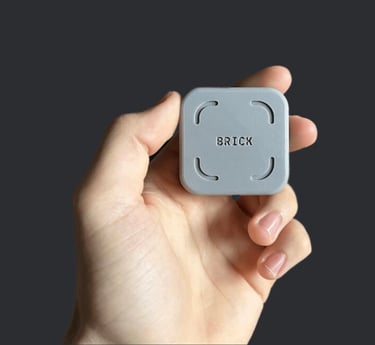
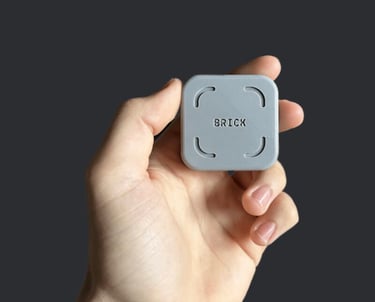
A “Brick” is a small cube that can be attached and stored almost anywhere. It is an intriguing invention within the digital minimalism movement that can block selected apps from being used. Once set up, you can only use your smartphone with the apps you have approved. If you want full access again, you must scan the “Brick” with your phone’s camera.
Now comes the brilliant idea behind the small cube: While digital apps such as Digital Wellbeing (Samsung) are easy to bypass, the owner has to physically walk to the Brick in order to regain full access. This separates the cube from digital software and places it in the physical environment.
In the video, however, Boke takes it a step further: He buried the Brick high up on a mountain under a stone. From that point on, if he wanted to use social media, he had to hike two kilometers uphill. He described the first two days as particularly exhausting and boring. Out of habit, he repeatedly reached for his smartphone, which now seemed monotonous and dull. As a result, he often climbed the mountain to access social media for entertainment.
On the third day, he created a plan for how to use the extra hours he had gained each day. Long overdue tasks around the house were completed. He gained more time for himself and his friends, allowed himself to do “nothing” more often, and pursued creative hobbies. Over time, this developed into an upward spiral that motivated him to start ambitious new projects of his own, such as his YouTube channel. Overall, the video demonstrates exactly what makes boredom so valuable: its ability to create meaningful impulses.
As we can see, digital minimalism has clear advantages if one is willing to take that step. In my own circle, I have friends who have decided to completely give up social media and news. On the other hand, I also know people who can hardly imagine life without these apps.
I have often reflected on this topic and would place myself in the second category. Social media as a means of communication holds great importance not only for me but for many others. It is no coincidence that we spend so much time on social platforms—we exchange ideas with friends and stay up to date through stories.
An abrupt break means losing certain social contacts and potentially experiencing “FOMO – Fear of Missing Out.” However, if we look at it objectively, we must ask ourselves:
What would truly change in my life if I gave up social media starting today?
In his video, Boke reported that at a certain point, he simply stopped caring about what other people were doing. I have heard the same from friends who have been off social media for some time. When it comes to staying in touch, there are always alternative ways to maintain contact—even if it is just through WhatsApp or SMS. Therefore, the advantages outweigh the disadvantages if one is willing to take this step.
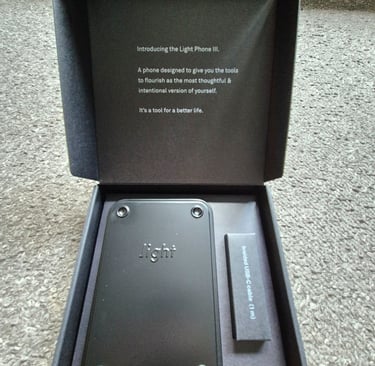
The Light Phone III
Just like the “Brick”, the Light Phone series is part of the digital minimalism movement. The company was founded in 2014 with the vision of reducing smartphone distractions and giving people more time back in their lives. These so-called “dumb phones” focus on reducing functionality to the essentials instead of offering 500+ apps competing for your attention.
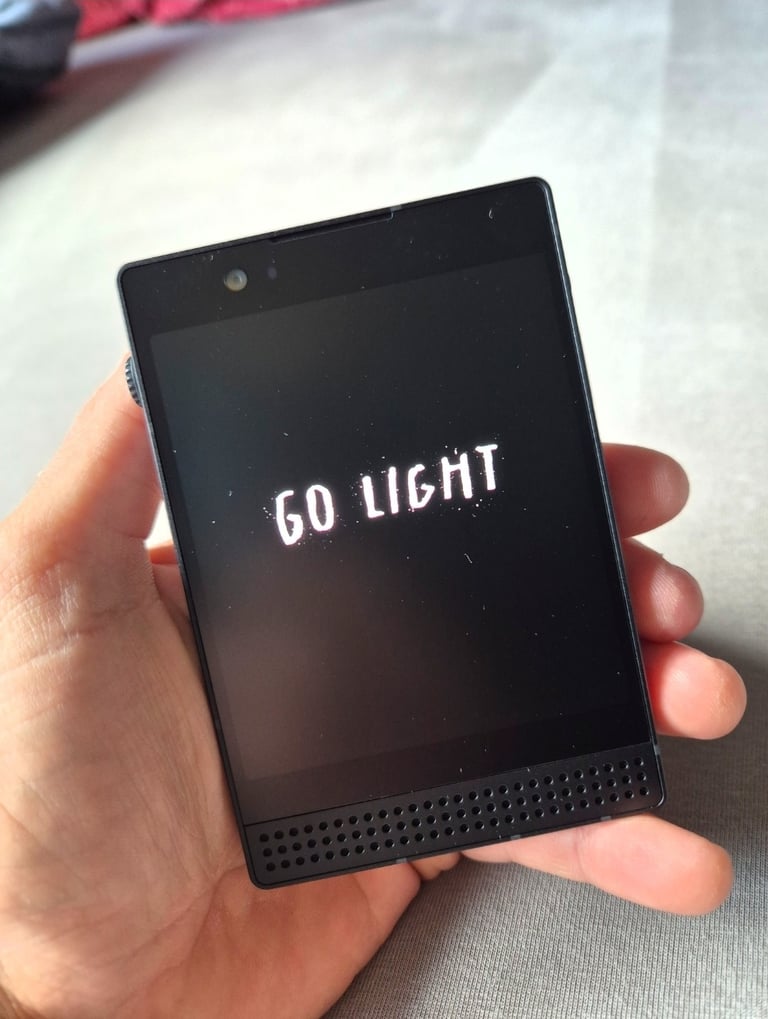
Over the past ten years, three models of the Light Phone series have been developed through crowdfunding campaigns. All models follow the same minimalist approach—whether through their simple design or their minimal feature set. How is it possible that a phone with fewer functions appeals more to some people? I would therefore like to give a brief review of my self-test of the Light Phone III.
In 2024, I reflected a great deal on digital minimalism and my own consumption habits. During that time, I discovered the Light Phone III, which was being promoted in a Kickstarter campaign. On paper, what impressed me most was the developers’ vision of consciously opposing the “always-on” smartphone culture—with the slogan: “Designed to be used as little as possible.” Technology is meant to serve people, not the other way around. While many devices promote stress, overwhelm, and constant distraction, the Light Phone deliberately aims to counteract this.
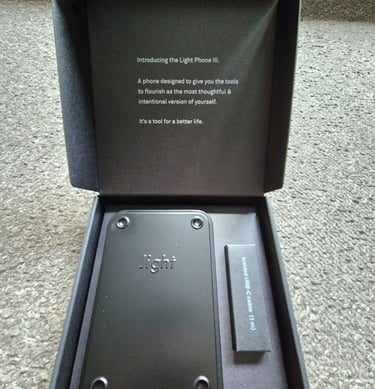
During the campaign phase, I decided to order one. It finally arrived at the end of 2025, giving me the opportunity to share my experiences.
Limiting Itself to the Essentials
The Light Phone III is the first model in its production line to feature both a camera and a removable battery. In terms of functionality, there is not much to say, as it offers only the following features:
Calendar
Notes
SMS
Camera
Hotspot
Podcasts
Music (offline)
Light Maps
NFC
Flashlight
It runs its own operating system called “LightOS”, which avoids app icons and a colorful display. Instead, everything is presented in a clean and simple design. For privacy reasons, other apps such as Spotify or WhatsApp cannot officially be used. In the future, however, Light is working on possibly implementing such features.
My first impression was somewhat skeptical, as relying solely on SMS and calls makes it harder to stay connected nowadays. Additionally, the Light Phone has no browser of its own, which significantly limits its range of use.
Nevertheless, I challenged myself to use this dumb phone as my primary device for two weeks. I repeatedly caught myself reaching for my Samsung to check potential WhatsApp messages. Of course, one could alternatively use WhatsApp via a web browser on a laptop, but that is rather inconvenient.
So a new solution was needed.
I came across a forum dedicated to exactly this issue. Many users complain that the Light Phone is not practical enough for everyday life in today’s world. I agree—especially since we encounter QR codes everywhere and much of our communication takes place via social networks. For me, the missing WhatsApp function was the main problem.
However, through a workaround, it was possible to put the Light Phone into developer mode and gain access to additional features and apps. This ultimately allowed me to install WhatsApp, a browser, and Spotify. Since then, all my previous issues with the Light Phone III have disappeared.
I now primarily use the Light Phone III when I need a “digital detox” or consciously want to avoid distractions. So far, it remains my secondary device in everyday life, as my smartphone is simply more convenient to use. And that is precisely the key point: Technology simplifies our lives—but it can also complicate them if we do not use it responsibly.
Conclusion
Digital minimalism is not a universal remedy for the problems of our media consumption. Helpful tools such as the Light Phone or the Brick can support us in becoming more mindful of ourselves and our relationship with technology. However, they do not necessarily address the root cause.
The true value of this movement lies not in renunciation, but in personal freedom of choice: When do I want to use technology—and when do I not?
That is a question everyone must answer for themselves. Therefore, I see digital minimalism more as an impulse toward a healthier relationship with technology rather than as an ultimate solution.

Never miss a post by subscribing to my newsletter! :)